The front of the shirt is empty. The cameras are still counting.
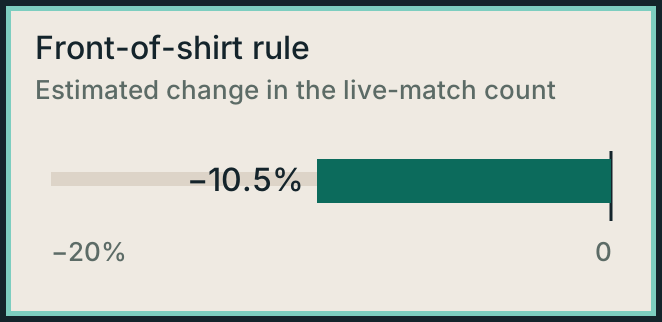
The 10.5 percent is an estimate of how the shirt rule changed a count of on-screen appearances. Sleeve and training-kit messages rose 363 percent, to 563, and the live-match total is still well above 2023.
- What was counted
- One appearance of a logo or other gambling reference. The same board counts again when it returns to the shot.
- Live matches
- 15,571 messages, 41.57 percent above the 2023 baseline.
- Shirt rule
- Estimated to account for a 10.5 percent reduction in that live-match count.
- Sleeves and kits
- 563 messages, a 363 percent rise on previous years.
- Sample
- Seven UK broadcasts, 21 to 24 August 2026. Footage of 26.8 hours.
The figure that will travel from this study is 10.5 percent. In the University of Bristol’s fourth annual count, that is the estimated effect of the Premier League’s front-of-shirt rule on live-match messages. A message, in this report, is an appearance. A logo counts again when the camera finds it again.
The paper is “Gambling Marketing and the Premier League: Four Years of Failed Self-Regulation”, October 2026. Raffaello Rossi, Saeid Moradipour, Jamie Wheaton, Maria Moxey and Johannes Singer wrote it. Bristol Business School and the Bristol Hub for Gambling Harms Research co-funded the work. iGaming Business and SBC News both reported it on 21 October. This desk read the executive summary and the methods section of the PDF Bristol has posted. It did not re-code the footage.
The matches are the opening weekend of the 2026/27 season, 21 to 24 August. Seven live UK broadcasts: Arsenal against Coventry on Sky, Hull against Manchester United on TNT, Brentford against Tottenham on Sky, Brighton against Aston Villa and Manchester City against Bournemouth on Sky, which overlapped, Newcastle against Liverpool on Sky, and Fulham against Chelsea on Sky. Pre-match, the match, half-time, the post-match and the ad breaks are included. The authors put the footage at 1,611 minutes and 53 seconds, which they call 26.8 hours. They also took Sky Sports News from 06:00 to 21:00 on Saturday 22 August, the window that covers the 15:00 blackout, and TalkSport across the same hours.
On social, the ten GB-licensed brands with the largest followings are Bet365, Betfair, Betfred, Betway, Coral, Ladbrokes, Paddy Power, Sky Bet, Unibet and William Hill. The report puts their combined following above 11.5 million. Paid ads on Meta were taken from the Ad Library for 21 to 24 August, with UK reach retrieved on 24 August. Organic posts on X cover the same dates. Added together, that Meta reach can include the same account in more than one ad. It is not a count of separate people, and it is not reach generated only on that weekend.
The coding rule is the part a sponsorship manager should read twice. One shot can hold several messages. Coders record the largest number of identical messages visible in a shot, and they tag the format: static and electronic hoardings, sleeves, training kits, lead-ins, commercial breaks, the stadium, and shirt fronts, which stay in the codebook after the ban. Agreement between coders, on Krippendorff’s alpha, ran from 0.91 to 1.00.
On that rule the live matches produced 15,571 messages, 41.57 percent above the 2023 baseline, the authors’ benchmark from before the code. The front-of-shirt restriction, which the Premier League set in 2023 and which is in force this season, is estimated to account for a 10.5 percent reduction in live-match messages. Messages on sleeves and training kits came to 563, a 363 percent rise on previous years. SBC described a 362 percent rise and wrote of sleeve sponsorships. The study’s own line is sleeves and training kits, and the rise is 363 percent.
Of the messages in the live broadcasts, 7,816 fell in the whistle-to-whistle window, 69.75 percent. Unlicensed brands were in 8.46 percent of live-match messages and in 8.84 percent of the Sky Sports News messages. On social, 93 percent of the content marketing was not clearly identifiable as advertising. In 2023 that share was 92 percent. Estimated reach on Meta to accounts aged 18 to 24 was 16.6 million instances. Instances, on the study’s own caveat, are not people.
iGaming Business, in its account of the study, adds two figures that were not on the summary pages read here. It reports at least one gambling message on screen for five hours and 16 minutes, close to a fifth of broadcast time, and pitchside boards as 72 percent of the messages at the live matches. Those two belong to iGB’s account.
Rossi, as both papers report him, said the result cannot be presented as a success for self-regulation, and that Premier League broadcasts carried more gambling messages per game than a comparison set that includes Germany, Canada and the United States. Both papers also report Sir Iain Duncan Smith, co-chair of the all-party parliamentary group for gambling reform, to the effect that the voluntary approach is failing and that clearing the shirt front barely scratched the surface. SBC notes that 19 of the 20 clubs agreed the restriction in 2023.
The two headline percentages answer different questions. The live-match count is 41.57 percent above 2023. The 10.5 percent is the authors’ estimate of how much the front-of-shirt rule itself changed that count of appearances. Sleeves and training kits are where the messages multiplied. The same board scores every time it comes back into the shot. Sponsorship income is a different number, and this report does not give it.