Korean police apprehended 6,310 people in a year of cyber-gambling cases.
Frozen proceeds are KRW154.8 billion. The year's investigative shift was toward vendors and the groups that build and parcel out the sites.
- The year
- National Office of Investigation, Korean National Police Agency, as reported on 19 November 2026 by Yonhap and by Financial News. 4,648 cases. 6,310 people apprehended. 316 detained. Financial News dates the 2026 intensive crackdown from 1 November 2025 through 31 October 2026. Yonhap gives November 2025 through October 2026 and does not print the days. Inside Asian Gaming reported the tally on 20 November.
- The rise
- Financial News: prior-year cases 3,544, prior-year apprehensions 5,196. Printed rises, 31.2 percent and 21.4 percent. 4,648 minus 3,544 is 1,104. 6,310 minus 5,196 is 1,114. Dividing 1,104 by 3,544 gives 31.2 percent. Dividing 1,114 by 5,196 gives 21.4 percent. Dividing 316 by 6,310 gives 5.0 percent. Those three percentages are this desk's divisions. The first two match the printed rates.
- The suppliers
- Yonhap: many sites shared one technical platform, so the investigation moved to vendor firms, which supply casino footage and game credits from overseas game companies, and to solution groups, which build a site, parcel it out, maintain it and resell credits. Financial News says that wider look began in the second half, through 20 dedicated teams and 98 officers at metropolitan and provincial agencies.
- Two stake figures
- Financial News. Daegu Metropolitan Police Agency forcibly repatriated a vendor ringleader from the United Arab Emirates after 12 years abroad. About 1,400 sites. Amount wagered above KRW9 trillion. Chungnam Provincial Police Agency: a solution group that built and parcelled out 188 sites. Amount wagered on the rooms it opened, KRW23 trillion. 78 people apprehended, operators included, 21 detained. Yonhap has the repatriation, the 1,400 sites, the 188 sites, the 78 and the 21. It does not print the 12 years, the KRW9 trillion or the KRW23 trillion. Inside Asian Gaming prints both stake figures. A stake is money wagered.
- People abroad
- Yonhap: custody of 158 suspects who had fled and who were wanted or notified. Among them, the ringleader of a KRW500 billion site who hired three teenagers as promoters, and the domestic ringleader of a group tied to sites on the order of KRW2.6 trillion. Financial News names the first as a Gyeonggi Bukbu case run from Dubai and elsewhere from December 2018 to July 2024, with the ringleader and a developer repatriated, 60 people apprehended and 18 detained. It names the second as a Chungbuk case, sites in Malaysia and elsewhere, the domestic ringleader repatriated from the United Arab Emirates, 87 people apprehended and 18 detained. It says the 158 were taken through a transnational-crime task force working with foreign agencies.
- Frozen proceeds
- Yonhap: KRW150.6 billion under pre-indictment preservation for confiscation and collection, plus KRW4.2 billion seized. The sum is KRW154.8 billion. 150.6 plus 4.2 is 154.8. Financial News: the year before was KRW123.5 billion, and the new total is KRW31.3 billion higher. 123.5 plus 31.3 is 154.8. Dividing 31.3 by 123.5 gives 25.3 percent. That percentage is this desk's division. Inside Asian Gaming converts KRW154.8 billion at US$116 million. This desk did not check the rate.
- Case mix
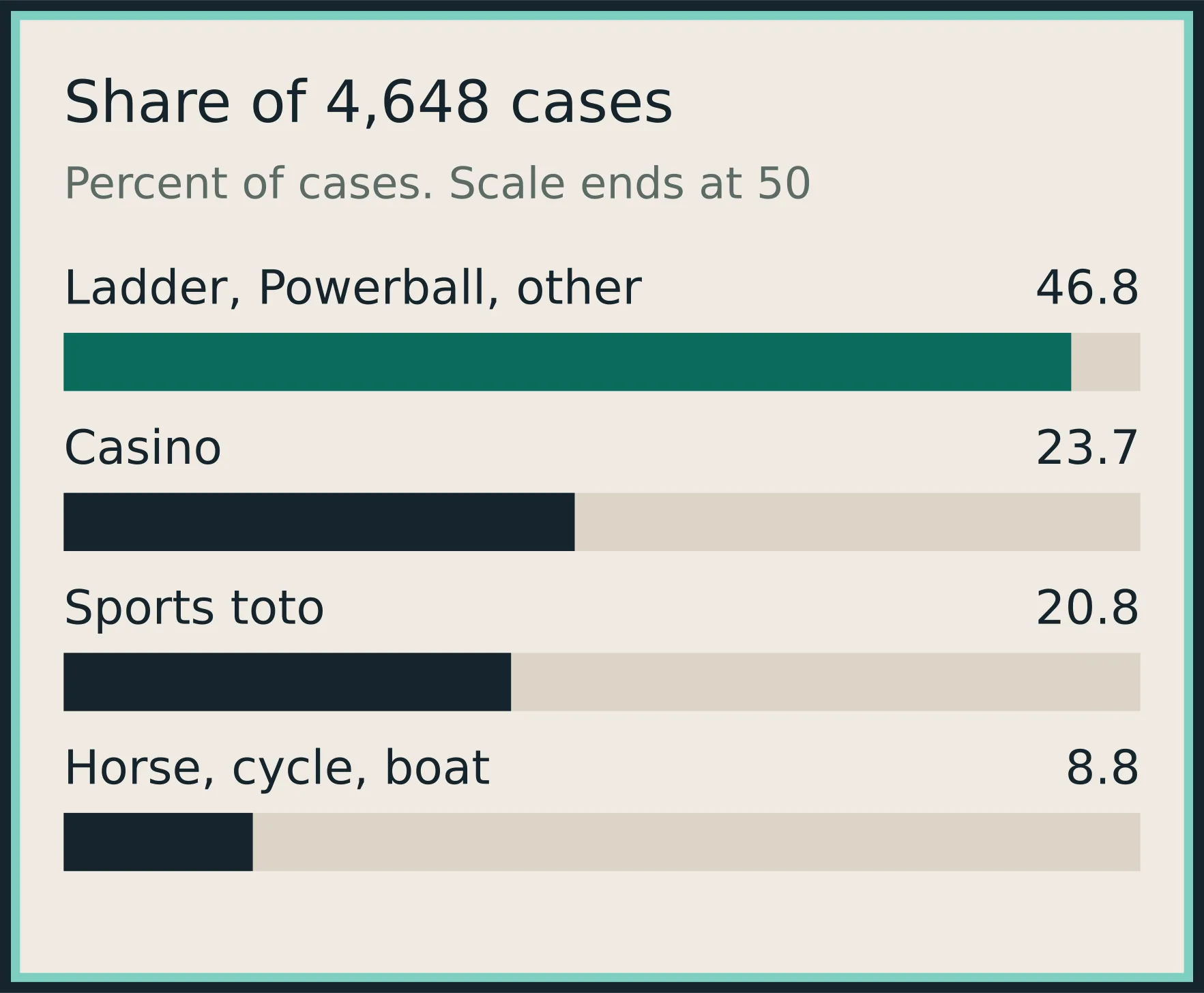
- Yonhap and Financial News, shares of cases. Ladder games, Powerball and other cyber games 46.8 percent. Casino 23.7 percent. Sports toto 20.8 percent. Horse racing, cycle racing and motorboat racing 8.8 percent. Those four shares add to 100.1.
- Ages
- Yonhap: 6,588 suspects, a count that includes people entered on the books and not apprehended. Thirties 26.1 percent, twenties 25.1 percent, forties 22.5 percent, teenagers 7.4 percent. Financial News adds fifties at 12.9 percent and age 60 and over at 6.0 percent. Those six shares add to 100. On sports toto, Financial News says twenties and thirties are 68.8 percent of suspects. On the three racing categories, it says age 50 and over is 68.0 percent.
- Youth path
- Yonhap: a first offence, or a small stake, goes to a youth guidance review committee and stays off the criminal book, so the arrest tables undercount teenagers. Cyber units sent 1,625 teenagers to that committee during the crackdown. Financial News: 1,777 people used a voluntary-reporting track and 1,593 were linked to specialist counselling. Dividing 1,593 by 1,777 gives 89.6 percent. From 16 November that window also covers narcotics, and it runs through 15 December. Yonhap dates the youth reporting period for cyber gambling and drugs through 15 December.
- Next round
- Both Korean reports: the 2027 intensive crackdown began on 1 November, still aimed at operators, at the firms that build and supply sites, at people abroad and at proceeds. Financial News: police have asked the broadcast and online-media review commission to block 906 gambling sites, and 147 cybercrime-prevention instructors are teaching students and soldiers. This desk did not open a National Police Agency press release.
South Korea’s National Office of Investigation closed a year of cyber-gambling enforcement with 6,310 people apprehended and 316 of them detained. The office, inside the Korean National Police Agency, gave the figures on 19 November 2026. Yonhap published them that morning. Financial News did the same. Inside Asian Gaming reported the tally on 20 November. The count is the 2026 intensive crackdown. Financial News dates it from 1 November 2025 through 31 October 2026. Yonhap gives those months and does not print the days. The cases number 4,648.
Financial News puts the previous year at 3,544 cases and 5,196 people apprehended. The rates both Korean reports print are a 31.2 percent rise in cases and a 21.4 percent rise in people apprehended. Subtracting the earlier counts leaves 1,104 more cases and 1,114 more people. Dividing 1,104 by 3,544 gives 31.2 percent. Dividing 1,114 by 5,196 gives 21.4 percent. Those two divisions match the printed rates. Dividing 316 by 6,310 gives 5.0 percent, the share detained.
The higher count is the year-on-year line. The change in method is the supply chain. Yonhap says operators were being caught and similar sites kept opening, so investigators looked for the platform underneath. Police had confirmed that many gambling sites ran on the same technical base. The next targets were vendor firms, which supply casino footage and game credits bought from overseas game companies, and solution groups, which build a site, parcel it out to an operator, keep it running and resell the credits. Financial News says that wider look began in the second half of the year. The work ran through 20 dedicated cyber-gambling teams, 98 officers, at the metropolitan and provincial agencies.
Two of those supply cases carry stake figures well above the money described as frozen. Financial News says the Daegu Metropolitan Police Agency forcibly repatriated, from the United Arab Emirates, a vendor ringleader who had been abroad for 12 years. He is accused of feeding about 1,400 sites, and the amount wagered on them is put above KRW9 trillion. Yonhap records the repatriation, the detention, the 1,400 sites and the overseas game-company credits. It does not print the 12 years or the KRW9 trillion. The same Financial News account says a Chungnam Provincial Police Agency case took in a solution group that built and parcelled out 188 sites and supplied the credits. The amount wagered on the rooms that group opened is put at KRW23 trillion. Police apprehended 78 people, operators included, and detained 21. Yonhap has the 188 sites, the 78 and the 21, and does not print the KRW23 trillion. Inside Asian Gaming prints both stake figures. The KRW9 trillion and the KRW23 trillion are amounts wagered. The frozen sum below is a different measure, and it covers the whole year.
Custody of people who had left the country is its own line. Yonhap says police secured 158 suspects who had fled and who were wanted or had been notified. Financial News says that work ran through a special task force on transnational crime, with foreign agencies. Inside the 158, Yonhap places the ringleader of a KRW500 billion site who had hired three teenagers as promoters, and the domestic ringleader of a group tied to sites on the order of KRW2.6 trillion. Financial News names the first as a Gyeonggi Bukbu case, run from Dubai and other places from December 2018 to July 2024: the ringleader and a developer were repatriated, 60 people were apprehended and 18 detained. It names the second as a Chungbuk case, sites run in Malaysia and elsewhere, the domestic ringleader repatriated from the United Arab Emirates, 87 people apprehended and 18 detained.
The sum police describe as frozen is KRW154.8 billion. Yonhap splits it into KRW150.6 billion held before indictment, under preservation orders for confiscation and collection, and KRW4.2 billion seized. Adding those two lines gives the KRW154.8 billion. Financial News says the year before stood at KRW123.5 billion, and that the new total is KRW31.3 billion higher. Adding KRW31.3 billion to KRW123.5 billion gives KRW154.8 billion. Dividing the increase by the earlier total gives 25.3 percent. Inside Asian Gaming converts the KRW154.8 billion at US$116 million. This desk did not check the rate.
On the mix of cases, Yonhap and Financial News agree. Ladder games, Powerball and other cyber games are 46.8 percent. Casino cases are 23.7 percent. Sports toto is 20.8 percent. Horse racing, cycle racing and motorboat racing are 8.8 percent. Those four shares add to 100.1, which is what one-decimal rounding does to a set of parts.
Ages are shares of a wider list than the 6,310. Yonhap says the suspects, including people entered on the books and not apprehended, number 6,588. People in their thirties are 26.1 percent, people in their twenties 25.1 percent, people in their forties 22.5 percent, and teenagers 7.4 percent. Financial News adds people in their fifties at 12.9 percent and people aged 60 and over at 6.0 percent. Those six shares add to 100. The age split also changes with the game. On sports toto, Financial News says people in their twenties and thirties are 68.8 percent of suspects. On horse, cycle and motorboat racing, people aged 50 and over are 68.0 percent.
Teenagers are a smaller share of that booked list because many of them never enter it. Police told Yonhap that a first offence, or a small stake, goes to a youth guidance review committee instead of being entered as a criminal case, so the arrest tables undercount youth gambling. During the crackdown the metropolitan and provincial cyber units sent 1,625 teenagers to that committee. Financial News describes a separate voluntary-reporting track: 1,777 people came forward, and 1,593 of them were linked to counselling at a specialist body. Dividing 1,593 by 1,777 gives 89.6 percent. From 16 November that window also covers narcotics. It runs through 15 December. Yonhap dates the youth reporting period for cyber gambling and drugs through 15 December as well.
The next crackdown has already started. Both Korean reports say the 2027 intensive cyber-gambling drive began on 1 November. It is still aimed at operators, at the firms that build and supply the sites, at people abroad and at the proceeds. Financial News says police have asked the broadcast and online-media review commission to block 906 gambling sites, and that 147 cybercrime-prevention instructors are teaching students and soldiers. This desk read Yonhap, Financial News and Inside Asian Gaming. It did not open a press release on the National Police Agency site.